
Part 4: The Genetics Problem
What Happens When A Civilisation Can’t Grow Freely?

This articles continues from Part 3: The Constraint Problem.
One of the things I’ve enjoyed about following this thought experiment is that each question seems to lead naturally to the next.
I haven’t had to force connections between unrelated ideas because, more often than not, the implications emerge on their own. If another branch of humanity survived underground for long enough to become a civilisation in its own right, then the constraints discussed in the previous article stop being temporary inconveniences and start becoming permanent features of life.
The people living within that system wouldn’t simply be enduring limitations while waiting for conditions to improve. For them, those limitations would become normal. They would shape institutions, expectations and values in ways that are difficult for those of us living on the surface to fully appreciate.
The more I thought about it, the more I realised that those constraints don’t just apply to food production, water management or ventilation. Eventually, they apply to people.
For most of human history, population growth has generally been regarded as a sign of prosperity and success. Larger populations meant more hands to work the land, more soldiers to defend borders, more opportunities for trade and, in many cases, greater resilience in the face of hardship. Families often had many children, partly because infant mortality was tragically common and partly because expanding populations could often be accommodated by expanding outward. New farmland could be cultivated. New settlements established. Trade networks extended. The system itself could grow.
A civilisation living permanently underground would find itself in a very different position.
Every additional person born into the settlement would increase demands on a system already operating within limits. More people would require more food. More food would require more production. More production would demand additional space, additional energy and additional maintenance. Even if new chambers could be excavated, they would bring their own costs in terms of ventilation, infrastructure and the practical problem of what to do with the material being removed.
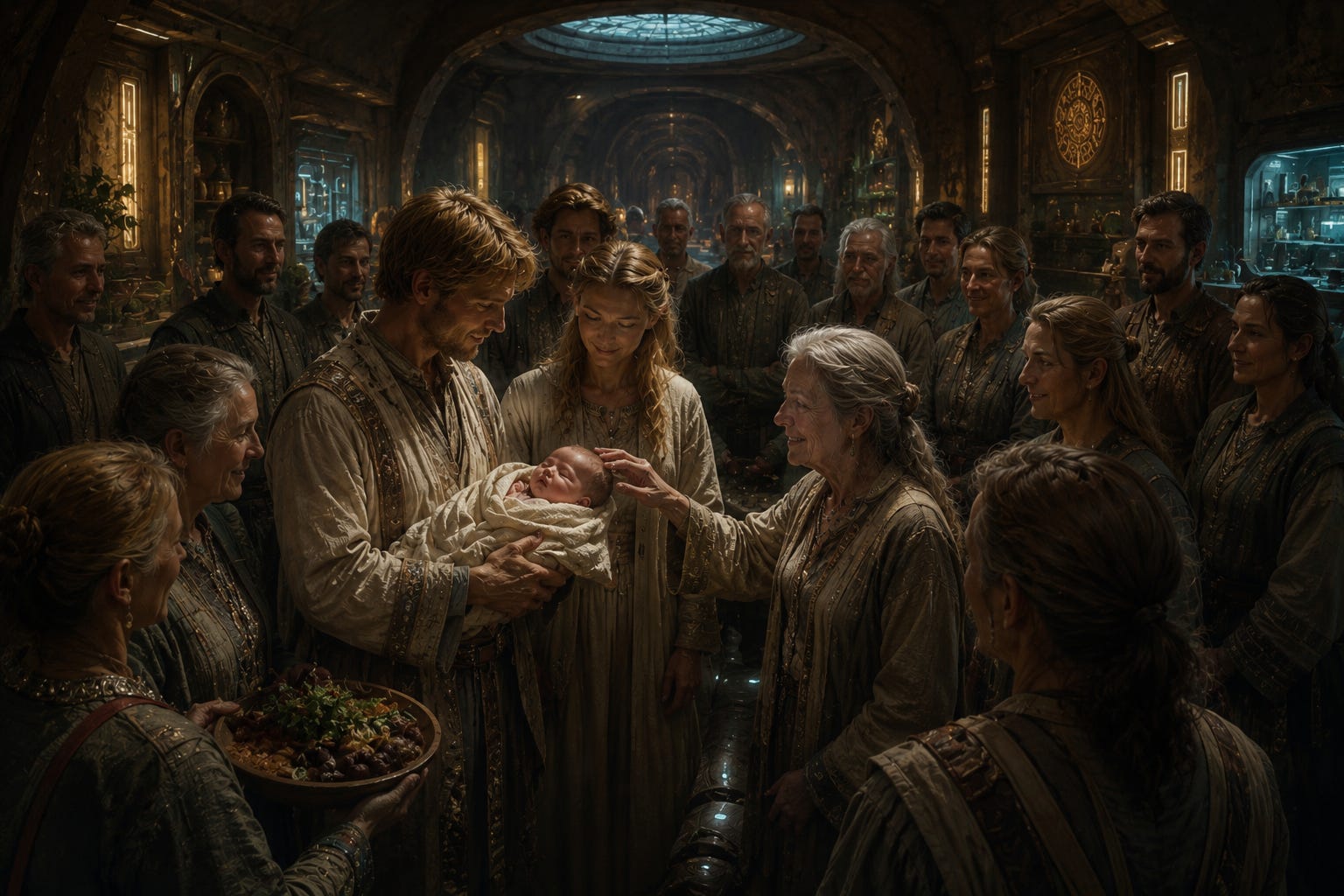
It isn’t difficult to imagine how this might gradually alter the way such a society thinks about reproduction. The question would no longer be whether children are valued. If anything, I suspect the opposite would be true. In a civilisation that can only sustain a relatively small number of births, each child becomes immeasurably important. Every birth represents an investment of finite resources. Every child carries hopes, expectations and responsibilities that extend beyond the immediate family.
The fewer children a society can realistically support, the more significant each one becomes.
It’s difficult to overstate how much this might alter the experience of childhood itself. In much of human history, children were born into large families and communities where infant mortality was common and life was often uncertain. In a closed civilisation with a relatively small and stable population, the opposite may be true. A child might represent one of only a handful of births within a particular generation. Their arrival would not simply be a private family matter. The wider community would understand that this child represents part of its future. Their education, health and wellbeing would carry significance that extends far beyond the immediate household. The fewer children a civilisation can afford to bring into the world, the more precious each one becomes.
Human history provides countless examples of cultures adapting their behaviour in response to environmental pressures. In times of abundance, populations expand. In times of scarcity, people make difficult choices. A hidden civilisation existing within a closed system might find itself making those choices not during moments of crisis, but as part of everyday life.
Perhaps children would be born less frequently. Perhaps prospective parents would delay having families until resources allowed it. Perhaps the health of both mother and child would become a matter of collective concern rather than purely private interest. A civilisation that can only afford a limited number of births each generation would have powerful incentives to ensure those children survive and thrive.
What struck me most wasn’t the possibility that such a society might become cold or calculating. If anything, I found myself wondering whether the opposite might happen. In a world where every person places demands on the system, but every person also contributes to its survival, individual lives may become extraordinarily precious. The engineer maintaining the ventilation system, the doctor treating illness, the teacher passing on essential knowledge and the farmer producing food are all threads in the same fabric. Lose enough of those threads and the entire system begins to weaken.
That way of thinking stands in sharp contrast to the assumptions of many surface societies. Here, growth is often treated as both natural and desirable. Underground, survival may depend not on growth, but on balance.
And once population itself becomes something that must be carefully managed, another question begins to emerge.
What happens to the genetic health of a civilisation that remains relatively small, relatively isolated and relatively stable for hundreds, or perhaps thousands, of years?
The Mathematics of Isolation
The thing I keep coming back to is that biology doesn’t particularly care about culture, intentions or good ideas.
You can build a stable society. You can develop sophisticated institutions. You can create systems that successfully balance food production, water supplies and population growth across generations.
None of that changes the underlying mathematics of small populations.
The more isolated a population becomes, the smaller the pool of genetic diversity available to it. At first, this may not be obvious. The first few generations might notice nothing unusual. Life carries on. Children are born. The society functions exactly as intended.
But over longer periods of time, biology begins to impose its own constraints.
This isn’t a controversial observation. Conservation biologists encounter it regularly when working with endangered species. Island populations often struggle with reduced genetic diversity. Small groups of animals that become isolated from larger populations can experience what geneticists refer to as founder effects and bottlenecks. Harmful traits that might otherwise remain rare become more common simply because there are fewer people available to dilute them. The population becomes less resilient. Less adaptable.
The same principles apply whether we’re talking about wolves, cheetahs or human beings.
The margin for error within a small, isolated society is simply much narrower. Surface civilisations can often absorb inefficiency because people are abundant and populations are constantly mixing. A closed civilisation may not have that luxury. Every death matters. Every illness matters. Every mistake carries consequences that echo through a much smaller pool of people.
That doesn’t necessarily mean such a civilisation would be fragile. If anything, it might become extraordinarily resilient. But resilience would likely come through vigilance rather than abundance. Problems that larger populations can afford to ignore may demand attention much earlier when there are fewer people available to share the burden.
What makes this thought experiment interesting is that the hidden civilisation has already solved so many other problems. It has survived whatever catastrophe forced it underground. It has built systems capable of sustaining life within strict environmental limits. It has adapted culturally to the realities of living within a closed environment.
Yet the very strategies that allow it to survive may gradually increase the importance of genetics.
If births are limited and the population remains relatively stable, opportunities for introducing new genetic combinations become correspondingly limited. The civilisation becomes successful precisely because it avoids unchecked growth, but that success may carry consequences that only reveal themselves over centuries.
I found myself wondering whether this is one of those problems that emerges so slowly that nobody notices it until it becomes impossible to ignore.
Perhaps it begins with an increase in certain inherited conditions. Perhaps physicians start noticing patterns that previous generations dismissed as coincidence. Perhaps fertility rates begin to shift. Perhaps susceptibility to particular diseases changes over time.
None of these developments would necessarily threaten the civilisation overnight. That’s what makes them so dangerous. They unfold gradually, often across multiple generations. By the time the pattern becomes clear, the population may already find itself confronting a problem that cannot be solved through better ventilation, improved agriculture or more efficient use of resources.
The irony is difficult to ignore. The very measures that keep the civilisation alive, limiting population growth and maintaining equilibrium within a finite environment, may also create the conditions for long-term biological decline.
Survival itself becomes a trap. And once a society recognises that its future depends not simply on managing resources but on maintaining the health of the population itself, another set of questions inevitably emerges.
If genetics matters this much, how far would a civilisation be willing to go to protect its future?
Would it simply hope that chance remains on its side?
Or would it begin looking for solutions?
The Prevention Question
Once a civilisation understands that its long-term survival depends not only on maintaining its environment but also on maintaining the health of its population, reproduction begins to look very different.
I don’t think the transition necessarily happens through ideology. It may not emerge from a grand philosophy or a desire to shape humanity according to some abstract ideal. It may arise from something far more ordinary.
Parents wanting healthy children.
Doctors wanting to prevent suffering.
Communities wanting future generations to inherit the best possible chance of survival.
Even today, many societies already intervene in reproduction to some extent. Prospective parents undergo genetic screening for inherited conditions. Pregnancies are monitored closely for developmental problems. Couples known to carry particular disorders sometimes seek medical advice before deciding whether to have children. We rarely think of these practices as controversial because they are framed around compassion and prevention rather than control.
A civilisation living within a closed system may simply take those same instincts further.
If each child represents a significant investment of finite resources, ensuring that child has the greatest possible chance of living a healthy life could become a collective priority. Preventing disease would almost certainly be preferable to treating it. Reducing suffering would be preferable to managing its consequences. Medical knowledge might increasingly focus not just on keeping people alive, but on improving the quality of life of future generations.
I also wonder whether this would gradually transform the role of medicine itself. Much of modern healthcare is concerned with diagnosing and treating illness after it appears. A civilisation living permanently within constraints may place increasing emphasis on prevention instead. Avoiding disease would be preferable to containing an outbreak after it begins. Preventing inherited conditions would be preferable to managing them later in life. The healthier each individual remains, the more resilient the system becomes as a whole. Over time, biology and medicine might cease to be merely practical disciplines and instead become central pillars of survival itself.
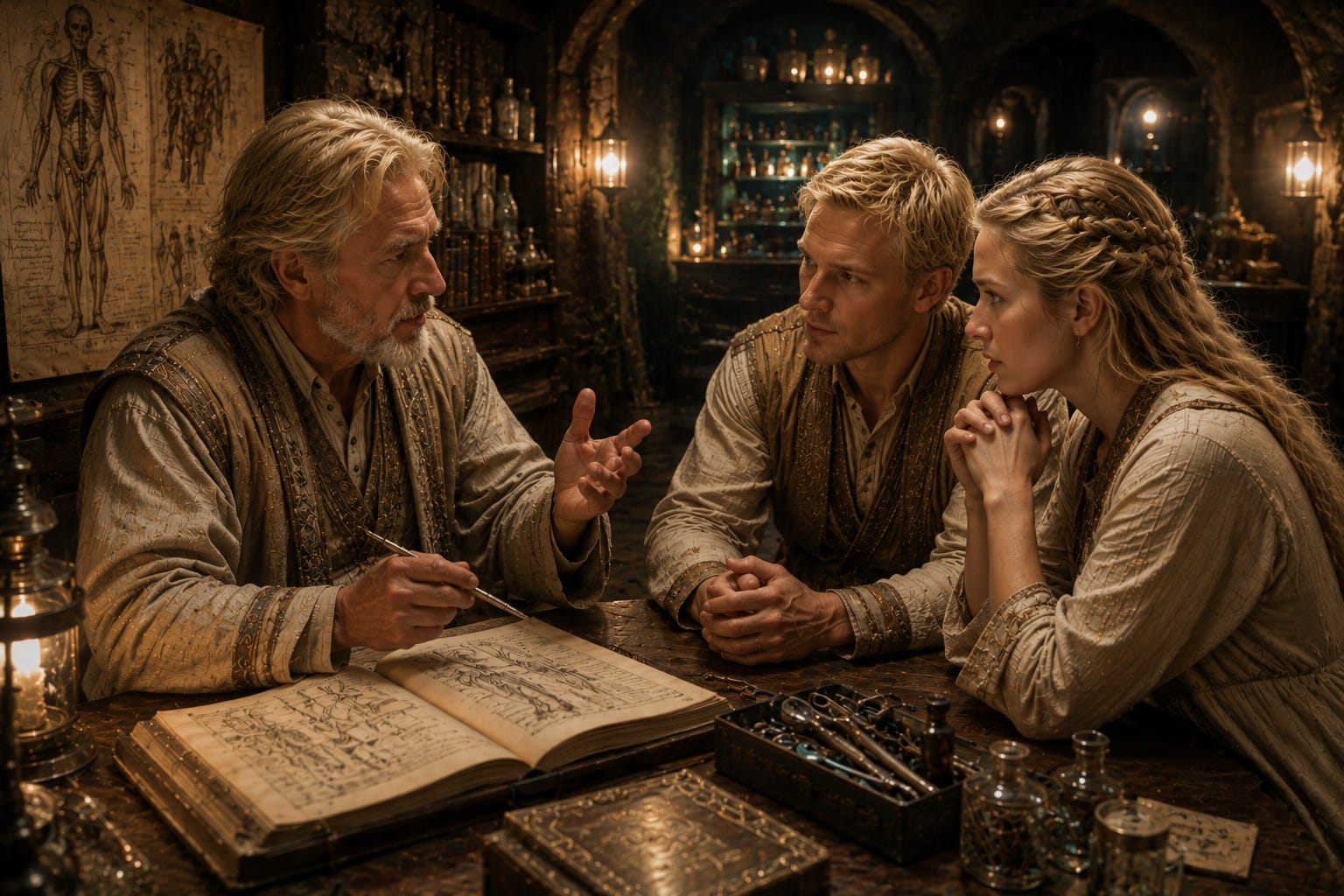
The difficult question is where that line eventually sits.
Would such a society merely encourage voluntary screening and informed decision-making? Would it provide guidance while leaving the final choices to individuals and families? Or would the pressures imposed by a closed system gradually push it towards greater intervention over time?
I don’t know. And I suspect the people living within that society might not know either.
The answers would almost certainly shift from one generation to the next, shaped by culture, necessity and experience. A population recovering from the memory of catastrophe might view these decisions differently from descendants born centuries later who have never known life beyond the boundaries of the system.
What seems unthinkable during one era can become normal in another, particularly when the original reasons for those decisions become woven into tradition.
There is another possibility worth considering.
We often imagine constrained societies becoming harsh because resources are limited. Yet a civilisation dependent upon a relatively small population may come to value people more, not less. Every individual represents accumulated experience, relationships, skills and knowledge that cannot be replaced easily. The death of an engineer responsible for maintaining vital infrastructure, a physician carrying decades of expertise or a teacher entrusted with preserving essential knowledge might be felt far beyond their immediate family.
In such a society, protecting life may become one of its highest priorities. Children would matter because there are so few of them. Adults would matter because each fulfils a role within the system.
The elderly would matter because they carry memories and understanding that younger generations have not yet acquired. After surviving catastrophe, knowledge itself may become one of the civilisation’s most precious resources. The people who understand how to maintain ventilation systems, diagnose disease, preserve food or teach essential skills are not simply older members of the community. They are repositories of hard-won experience. Extending healthy lifespan may therefore become more than an act of compassion. It may become a practical necessity.
The more I thought about it, the less this resembled the caricature of a cold, authoritarian civilisation making ruthless calculations about human worth. Instead, I found myself wondering whether the opposite might emerge. A society shaped by scarcity may come to recognise something that larger populations often forget.
That people are not infinitely replaceable.
And yet, no matter how compassionate its intentions might be, the underlying problem remains.
A relatively small, relatively isolated population cannot rely indefinitely on chance to maintain its genetic health.
Sooner or later, if the civilisation hopes to endure, it must confront a question that becomes increasingly difficult to avoid.
Where does new diversity come from?