
Part 1: The Hidden Humanity Hypothesis
What if another branch of humanity has been sharing this planet with us all along?

This article is the starting point for what I call The Hidden Humanity Hypothesis.
The possibility that some UAP intelligence may not be extraterrestrial, but a separated branch of humanity that survived an ancient catastrophe, retreated underground or underwater, and developed beyond our sight.
The wider theory is not built around one claim, one sighting or one piece of evidence. It is a chain of possibilities. If a population survived below the surface, what would happen to its memory, culture, biology, technology and relationship with the world above?
The series explores that question step by step:
Part 1: The Hidden Human Hypothesis
Introduces the central question: what if some of the phenomenon is not alien, but another branch of us?Part 2: The Child Who Never Saw the Sky
Explores how quickly memory, culture and identity could change if generations were born underground and never experienced the surface world.Part 3: The Constraint Problem
Looks at the physical limits facing any hidden civilisation: air, water, food, space, waste, energy and population.Part 4: The Genetics Problem
Examines why isolation would eventually create biological pressures, and why genetics may become central to survival.Part 5: When the Earth Began Looking Back
Explores how surface humanity’s technological growth may have made passive concealment harder to maintain.Part 6: The Great Departure
Follows the possibility that fixed underground settlements became liabilities, forcing hidden humanity to become mobile and eventually move toward the oceans.
You do not need to read every part before continuing, but the wider argument becomes clearer when seen as a chain: catastrophe, separation, adaptation, constraint, detection, migration and divergence.
The Comment I Couldn’t Stop Thinking About
A few months ago I was listening to David Grusch discuss the possibility that at least one of the intelligences humanity may be interacting with could be only a few hundred years ahead of us technologically.
For those unfamiliar with Grusch, he is the former intelligence officer whose allegations about secret UFO retrieval programs brought him to public attention in 2023.

It wasn’t the main point he was making, and it wasn’t presented as some earth-shattering revelation. It was simply a passing observation. Yet it was the part of the conversation that stayed with me long after everything else had faded into the background.
The reason it stuck with me is that it quietly challenges one of the assumptions beneath almost every discussion about UFOs and non-human intelligence.
Most people, consciously or otherwise, begin with the idea that whatever we are dealing with must be vastly more advanced than we are. The image that tends to come to mind is a civilisation that has crossed interstellar distances, mastered technologies that appear almost magical to us, and exists so far beyond our own level of development that meaningful comparison becomes difficult.
But a civilisation only a few hundred years ahead of us is a very different proposition.
If somebody living in the year 1700 were transported into the modern world, much of what they encountered would appear miraculous. They would see aircraft crossing continents in hours, moving images transmitted around the globe instantly, submarines disappearing beneath the oceans for months at a time, and weapons capable of destroying entire cities.
From their perspective, the gap would be extraordinary. Yet we would still recognise one another as human. We would share the same origins, the same basic psychology and many of the same motivations. The technological distance would be immense, but it would not be incomprehensible.
The more I thought about Grusch’s comment, the more it pushed me towards a question I had not seriously considered before. If we are potentially talking about a civilisation only a few hundred years ahead of us, why do we automatically assume it crossed the gulf between the stars rather than emerging from somewhere much closer to home?
If we are potentially talking about a civilisation only a few hundred years ahead of us, why do we automatically assume it originated somewhere else?
Before going any further, I should make something clear. I am not claiming this is true. I am not claiming to have solved the UFO mystery, nor am I suggesting that every aspect of the phenomenon can be explained through a single theory. What follows is simply a thought experiment, and a framework for looking at the problem from a different angle.
The idea itself is straightforward.
What if at least some of the intelligence behind the phenomenon is not extraterrestrial at all?
What if it is another branch of humanity?
Not future humans travelling backwards through time. Not a secret civilisation that emerged during the twentieth century. Something much older.
A population that survived an ancient catastrophe by retreating underground while civilisation on the surface collapsed, fragmented or was forced to rebuild from a much lower baseline.
I do not know if that is what happened. What interests me is that once I started exploring the possibility, a number of seemingly unrelated aspects of the phenomenon began to fit together in ways I had not expected.
Humans Already Have a History of Going Underground
One of the reasons this idea appealed to me is that it does not begin with UFOs.
It begins with human behaviour.
When the surface becomes dangerous, humans often look for safety beneath it. War, invasion, persecution, environmental stress and political instability have all pushed people underground at different points in history. Sometimes that meant caves. Sometimes tunnels. Sometimes bunkers. Sometimes entire subterranean settlements.
We see this pattern again and again.
The underground city of Derinkuyu in modern-day Turkey is probably the most famous example. Along with nearby sites such as Kaymakli, it forms part of a vast network of subterranean settlements carved into the soft volcanic rock of Cappadocia. These were not natural caves that people happened to occupy. They were engineered environments complete with ventilation shafts, water access, food storage areas, living quarters and defensive features designed to isolate sections of the complex if necessary.
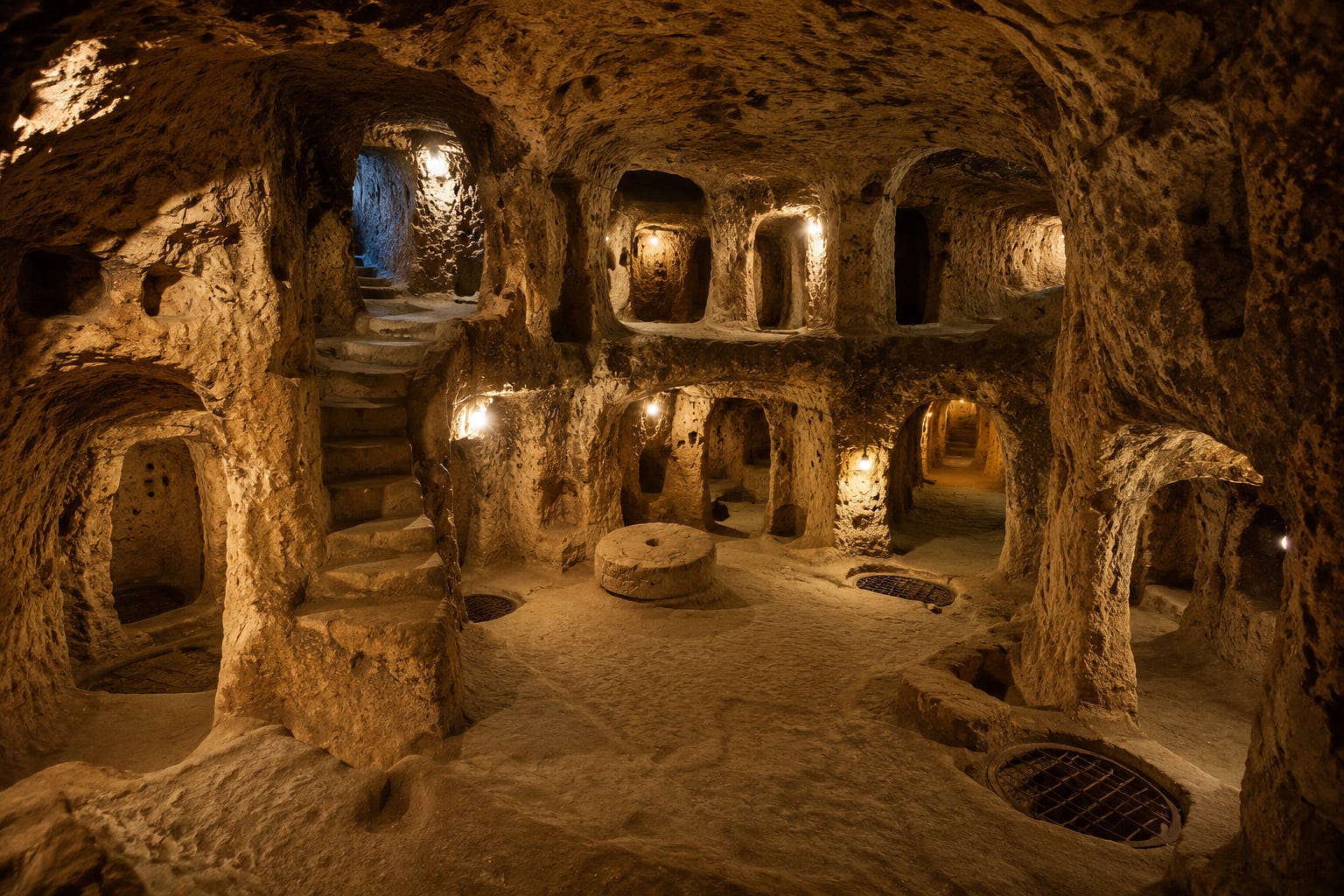
What makes sites like these interesting isn’t simply their size. It’s the fact that they were built with long-term survival in mind.
According to UNESCO, the underground settlements of Cappadocia represent some of the most remarkable examples of subterranean habitation ever discovered. Estimates vary, but Derinkuyu alone may have been capable of sheltering many thousands of people together with livestock, food and essential supplies. Whether the exact number was ten thousand, twenty thousand or something in between is less important than what the existence of the site tells us about the people who built it.
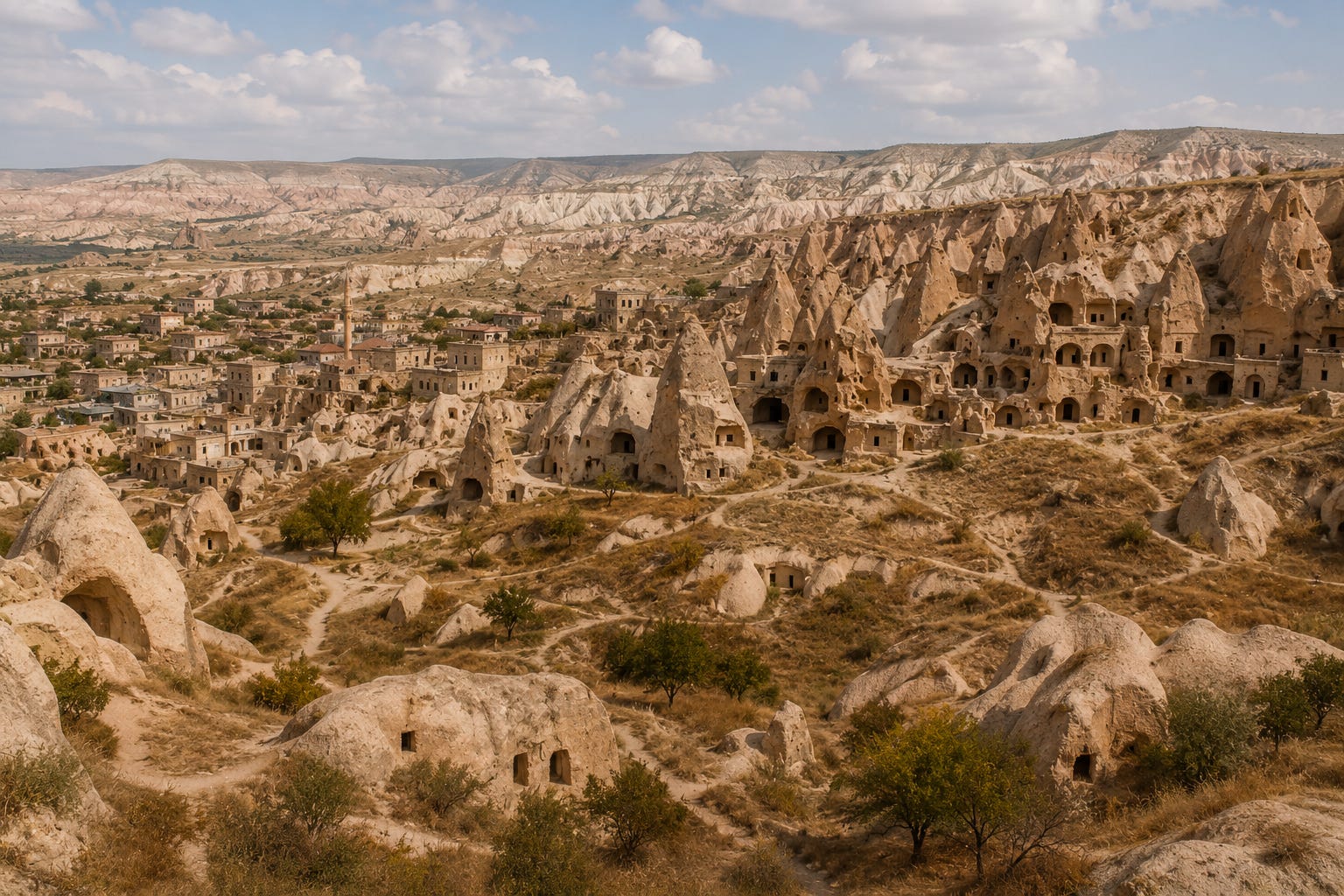
Nobody undertakes a project of that scale unless they are preparing for the possibility that life above ground could become dangerous enough to abandon, at least temporarily.
Nor is Turkey unique.
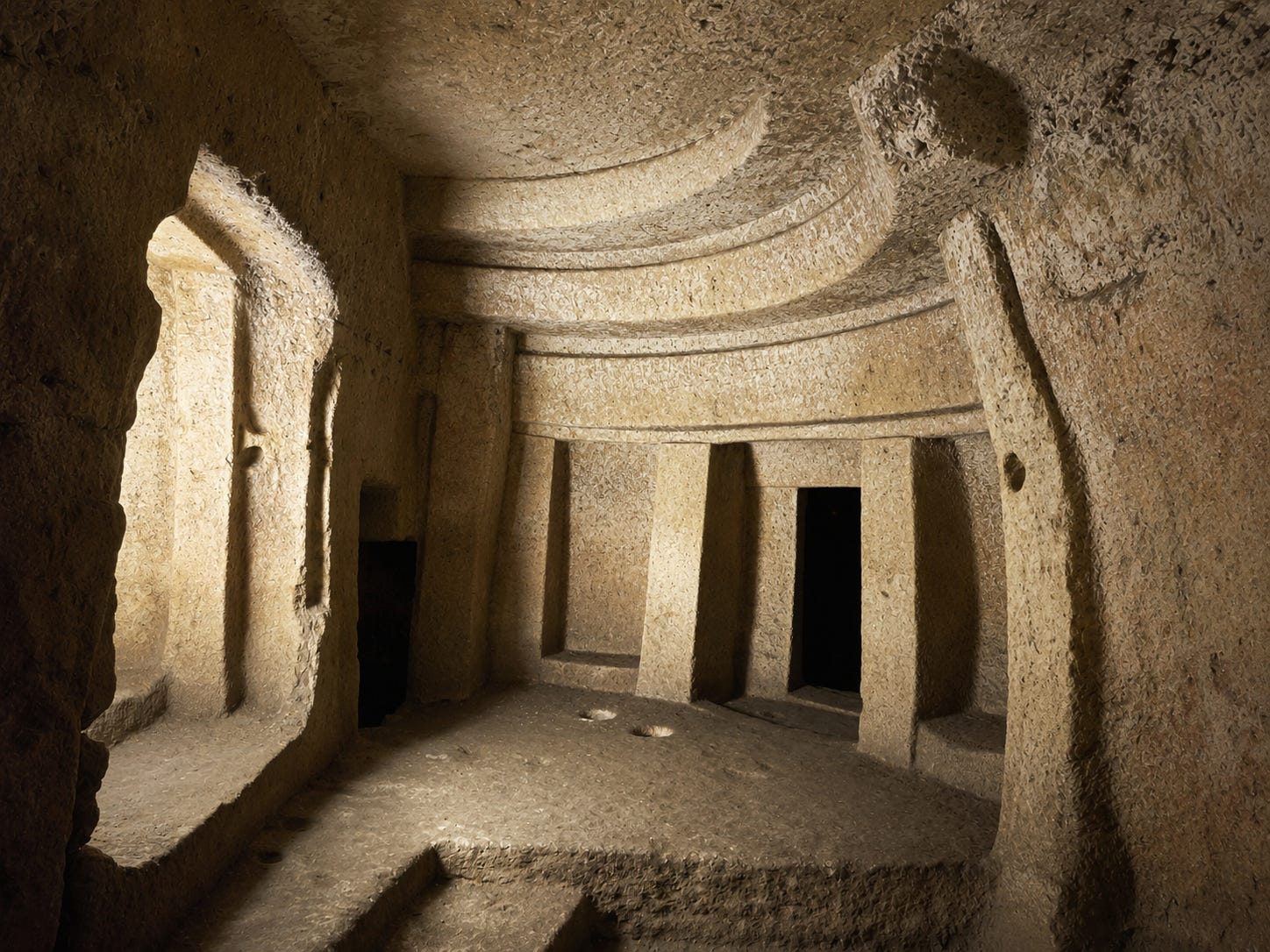
The underground refuge of Naours in France sheltered local populations during periods of conflict. During the twentieth century, governments around the world invested enormous resources in continuity-of-government facilities designed to preserve political leadership and critical infrastructure in the event of nuclear war.
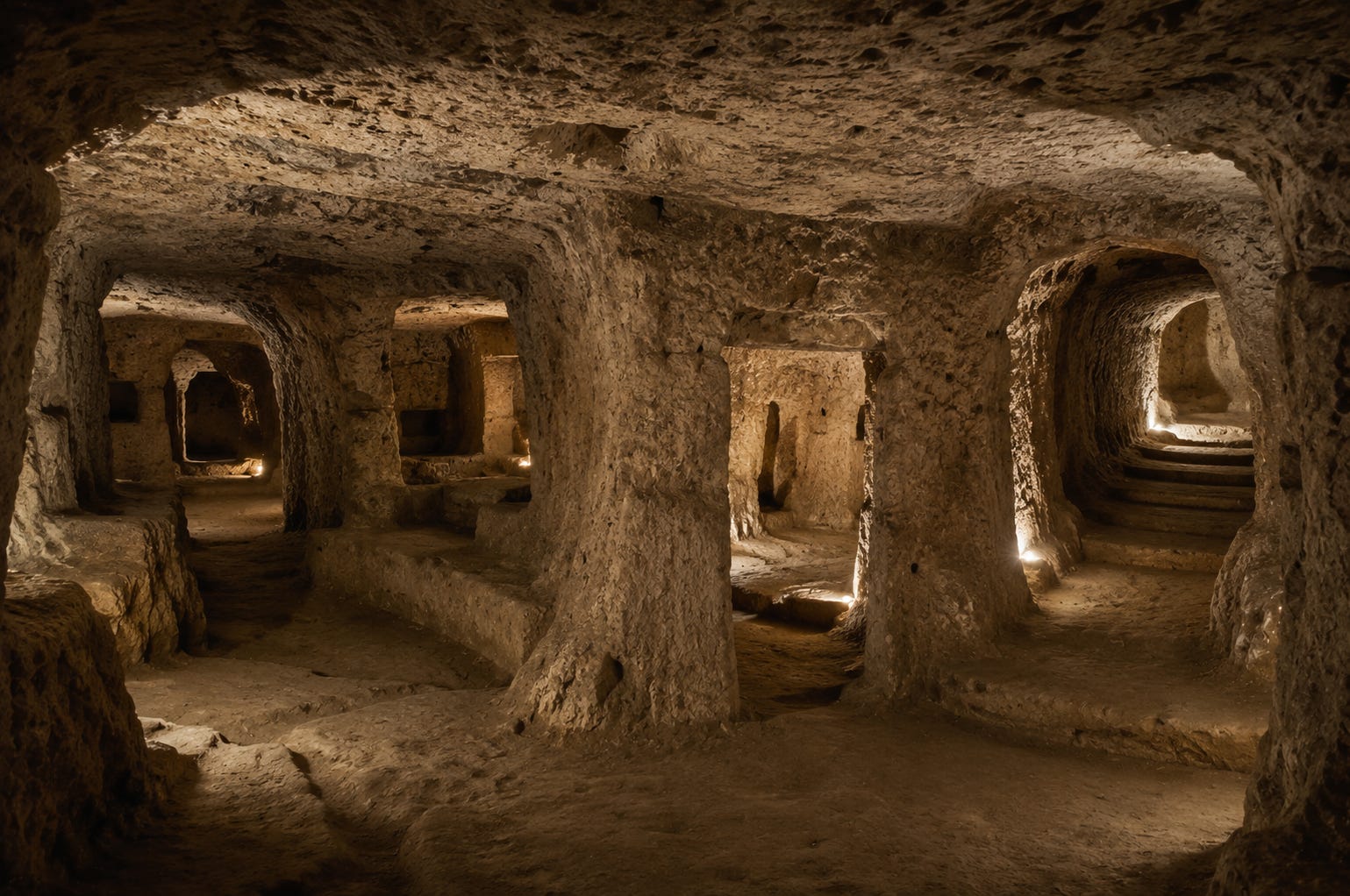
Although these sites emerged in very different historical periods and for very different reasons, they reveal a recurring pattern in human thinking.
When we believe the surface world may become hostile, we build refuges.
We create backup plans.
We look for ways to preserve continuity through periods of uncertainty.
What struck me as I looked into these places wasn’t the engineering itself, impressive though it is. It was the mindset behind it. Modern visitors tend to view underground cities as archaeological curiosities, but the people who built them almost certainly saw them very differently. To them, these places represented security, resilience and the possibility of survival if circumstances deteriorated badly enough.
In other words, the existence of underground settlements does not prove the Hidden Humanity Hypothesis.
Far from it.
What it does demonstrate is something much simpler and much more important. The idea of human beings retreating underground during periods of crisis is not speculative. It is something we know humans have done repeatedly throughout history.
The speculative part begins later.
The speculative part begins when we ask what happens if one group stays underground longer than everyone else.
The Question Nobody Seems to Ask
The question that eventually occurred to me wasn’t why humans go underground.
That part is relatively easy to understand. Throughout history, people have sought shelter from threats they believed they could not confront directly. Whether the danger came from invading armies, environmental disasters, political instability or the possibility of war, the logic remained the same. If the surface becomes dangerous enough, survival may depend on finding somewhere else to ride out the storm.
The question that interested me was what happens afterwards.
Imagine a serious civilisational collapse. Not necessarily an extinction event, but something severe enough to disrupt large populations, destroy infrastructure and erase much of what came before. One group survives underground while the surface world struggles to recover.
At first there is little difference between them.
They share the same history, the same language, the same culture and the same technology. If contact remains possible, they may even continue to think of themselves as part of the same civilisation.
But time has a way of creating distance.
A decade passes, then another. Memories remain fresh at first. Names, places and events still belong to living people. The separation may feel temporary, even reversible.
Then a century passes.
Then several.
Gradually, the problems facing each group begin to diverge.
The people rebuilding on the surface are concerned with agriculture, trade, territory, conflict and expansion. Their environment rewards adaptability, exploration and competition. They are focused on reclaiming a world that has been damaged or abandoned.
The people below ground face a completely different reality. Their concerns revolve around resource management, disease control, population stability and the maintenance of a closed environment. Space is limited. Mistakes are costly. Long-term planning becomes a necessity rather than a luxury.
Both remain human, but they are no longer being shaped by the same world.
Neither group is necessarily more advanced than the other. They are simply adapting to different circumstances. One is shaped by openness, expansion and exposure. The other is shaped by containment, caution and control.
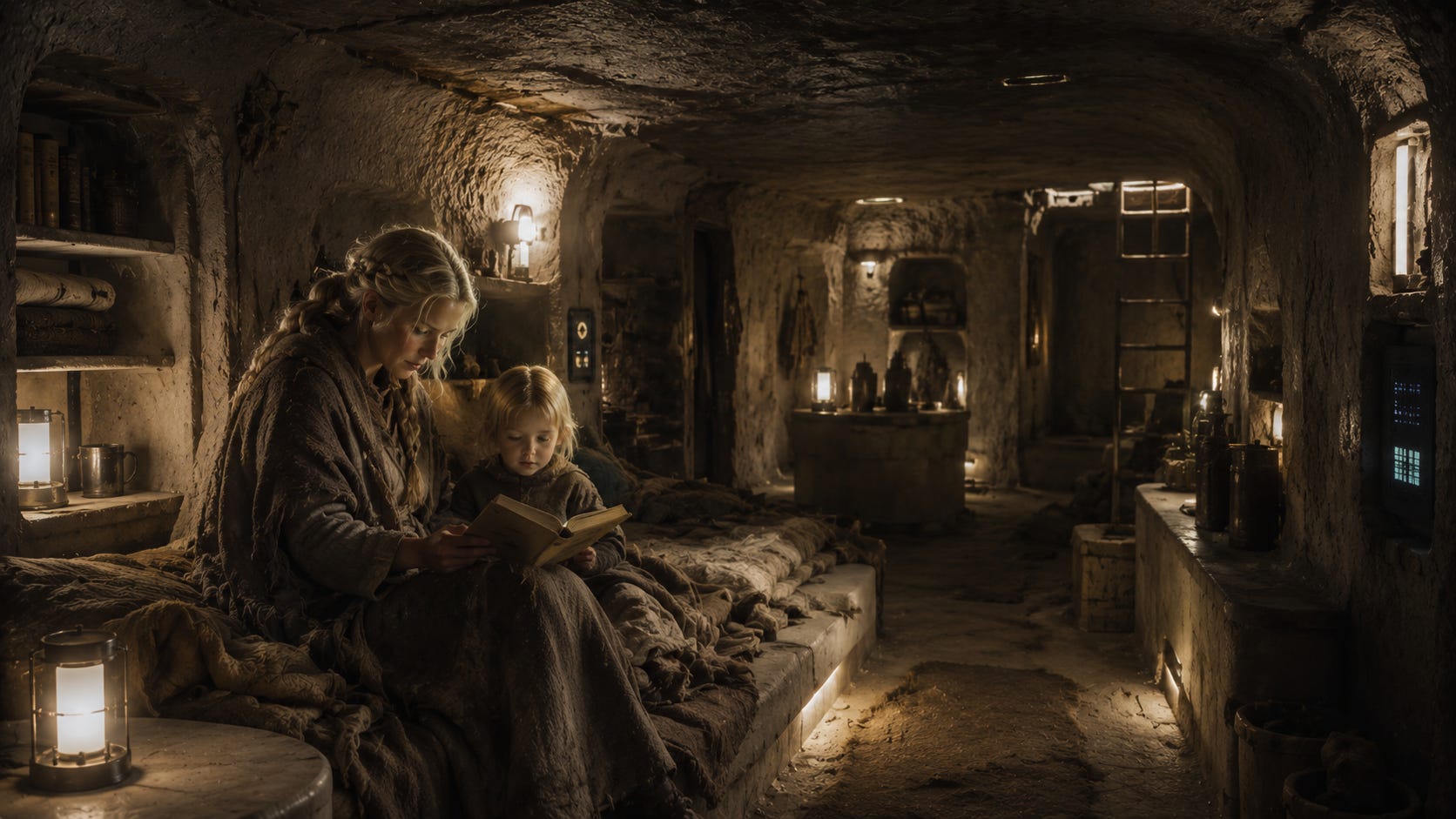
But given enough time, those differences begin to compound. Priorities change. Institutions evolve. Cultural values shift. Technologies develop in response to different pressures. Eventually, the two groups may find themselves living in entirely different worlds despite sharing the same origins.
This process does not require thousands of years to begin. We can already see how quickly populations diverge when separated by geography, politics, religion or ideology. Human history is full of examples of communities developing distinct identities after only a few generations of isolation.
Extend that process across centuries or millennia and the implications become difficult to ignore.
At what point does a separated population stop being part of the civilisation it came from, and become something new?
This is where the Hidden Human Hypothesis really begins. Not with UFOs, alien visitors or advanced technology, but with the possibility that two branches of the same species could follow different historical paths for long enough that they eventually become strangers to one another.
If that happened, we might expect them to look at the world very differently. We might expect them to develop different technologies, different priorities and different ways of organising society. We might even expect them to regard us, and for us to regard them, with a mixture of curiosity, caution and misunderstanding.
Whether any of this actually occurred is another question entirely.
What interests me is that once you allow for the possibility, a surprising number of other questions begin to emerge naturally from it: questions about genetics, technology, secrecy, oceans and even some of the reported behaviours associated with the UFO phenomenon.
The further I followed that line of reasoning, the more it felt less like an alien hypothesis and more like a forgotten branch of human history.
Why This Idea Keeps Pulling Me Back
The thing I find most interesting about the Hidden Humanity Hypothesis is not that it explains everything.
It clearly does not.
In fact, one of the themes I want to explore throughout this publication is where the theory stops being useful. There are aspects of the wider phenomenon that may have nothing to do with it whatsoever. Any framework that claims to explain every craft, every entity, every encounter and every anomaly is probably trying to do too much.
What keeps pulling me back is something simpler.
The theory appears capable of connecting several different observations through a single chain of reasoning.
Most discussions around UFOs tend to fragment into separate mysteries. There are the craft. There are the entities. There are reports involving genetics. There are recurring claims about nuclear weapons. There are stories involving oceans, underground facilities, government secrecy and environmental concern. Each topic often develops its own explanation, its own literature and its own assumptions.
The result can feel less like a coherent picture and more like a collection of disconnected puzzles.
The Hidden Humanity Hypothesis approaches the problem from a different direction. Instead of asking what separate explanation might account for each observation, it starts with a single premise and follows the consequences.
Let’s assume, only as a thought experiment, that a population survived separately from the rest of humanity for a sufficiently long period of time.
What follows from that?
The first consequence is obvious. They would have reasons to monitor the surface world because they still share the same planet.
The second is equally obvious. They would be affected by environmental damage, climate shifts, pollution and nuclear conflict just as much as we would, perhaps more so depending on where and how they lived.
A small, isolated population would eventually face genetic challenges, making biology and medicine critically important fields of study. If they wished to expand, remain healthy or avoid long-term genetic decline, access to fresh genetic material could become strategically important.
Secrecy also becomes easier to understand. Human history is not particularly encouraging when it comes to encounters between societies with large technological imbalances. The outcome is often exploitation, conflict or domination. If another branch of humanity understood that lesson, maintaining separation might seem preferable to open contact.
From there, the implications begin to widen.
If such a civilisation survived underground, it would eventually face limits of space, energy, food, water, waste, population and genetic diversity. If surface humanity became more technologically capable, passive concealment would become harder to maintain. If fixed underground settlements became detectable, mobility would become valuable. If mobility became essential, enclosed habitats would matter. If those habitats needed to move through rock, ocean or air without being easily found, then pressure control, stealth, environmental isolation and perhaps even bubble-like boundary technologies would become logical areas of development.
None of that proves the theory. But once you take the initial premise seriously, the idea does not shrink. It expands.
That distinction matters. I am not arguing that this hypothesis is correct. I am arguing that it appears internally consistent. When I follow the chain of consequences from the original premise, I find myself making fewer leaps than I do with many traditional extraterrestrial explanations.
Perhaps that is because the hypothesis is pointing towards something real. Perhaps it is because the human brain naturally prefers coherent stories. I genuinely do not know.
What I do know is that the further I follow the logic, the more difficult I find it to dismiss outright.
The interesting thing is that this article has only explored the starting point of the idea. It asks whether a separated branch of humanity could exist. It does not yet address what centuries or millennia of separation might do to such a population.
After all, the first generation would remember the surface world. They would remember the sky, the seasons, the oceans and the landscapes their ancestors once inhabited. Their children would inherit those memories second-hand through stories and traditions.
But what about the generations that followed?
At some point, nobody would remain who had seen the surface for themselves.
The sky would become something described rather than experienced. Vast oceans, mountain ranges and open horizons would exist only in stories told by parents and grandparents. Over time, those stories might be preserved faithfully, distorted through retelling or dismissed as mythology.
That raises a question I find difficult to stop thinking about.
How long does it take for a population to forget the world it came from?
In Part 2, The Child Who Never Saw the Sky, we’ll explore what long-term isolation does to human societies, how cultures diverge over time, and what happens when an entire generation grows up knowing the surface world only through stories.